
Why does a new concrete floor crack?
Most cracks in a house or garage floor come from concrete drying too fast, too much water in the mix, a soft or uneven base, no control joints, or no reinforcement (or mesh lying on the soil where it does nothing). You cannot stop concrete from shrinking, but you can control it: compact the base, cut joints, cure the slab, and put 2×2 inch steel matting in the slab, held up on chairs, so cracks stay hairline-thin instead of opening up. Wide, growing or uneven cracks need an engineer to look at them.
Almost every concrete floor cracks a little. Concrete shrinks as it dries, and in Philippine heat it can lose water fast. The question is whether you get a few thin lines along the joints, or wide cracks that open, chip, and let one part of the floor sink below the other (nagcrack at lumubog ang sahig). This guide covers the seven usual causes, how to tell a harmless crack from one that needs attention, and what to do on your next pour so it does not happen again.
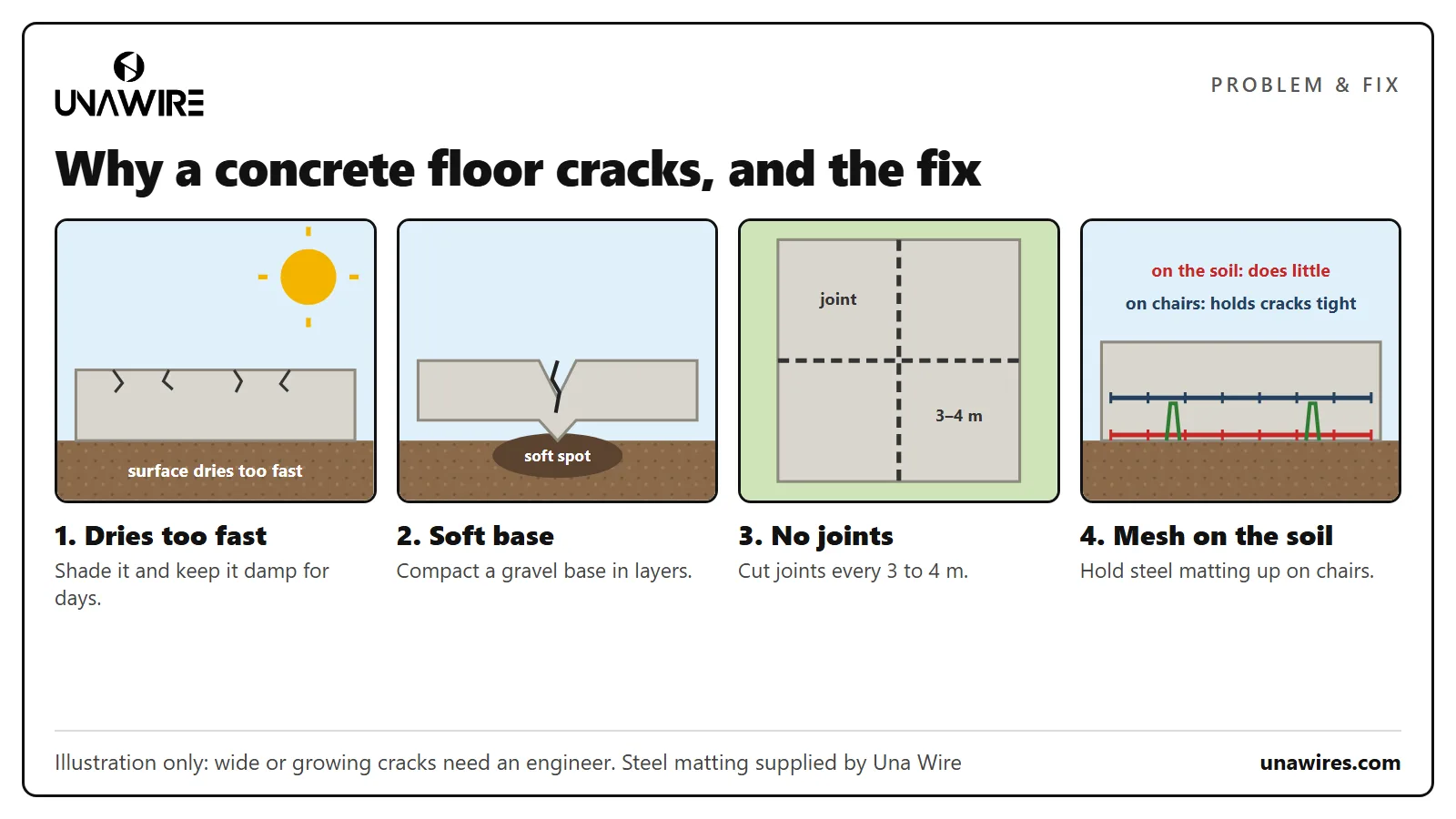
7 Reasons a Concrete Floor Cracks
1. The surface dried too fast
Sun, wind and hot weather pull water out of the top of fresh concrete before it has set. The surface shrinks faster than the concrete below and splits into short, shallow cracks, often in a random "map" pattern, within hours of the pour. Fix: pour early in the day or late afternoon, shade the area, and keep the slab damp for several days (wet sacks, plastic sheet or regular spraying).
2. Too much water in the mix
Adding water makes concrete easier to spread, but the extra water has to leave as the slab dries, and the slab shrinks more. It is also weaker. Fix: mix to the proportion your engineer or contractor gave you, and do not add water on site to make it "flow".
3. The base under the slab is soft or uneven
Loose fill, soft clay, old garbage pits or a poorly compacted area settles after the floor is cast. The slab loses support, bends, and cracks over the soft spot. These are the cracks that let one side sink. Fix: remove soft material, add a gravel base and compact it in layers before you pour.
4. No control joints
A large slab with no joints decides for itself where to crack. Fix: form or saw-cut control joints, commonly into squares of 3 to 4 m, so the shrinkage crack forms neatly at the bottom of the joint where you cannot see it.
5. No reinforcement at all
Plain concrete is strong when pressed but weak when pulled. Once it cracks, nothing holds the two sides together, so the crack keeps opening. Fix: put steel matting in the floor slab. The steel crosses every crack and keeps it tight.
6. Mesh was there, but on the ground
This is one of the most common problems we hear about. The mesh was laid flat on the soil and workers walked on it during the pour, so it stayed at the bottom and does little. Fix: set the mesh on chairs so it sits inside the slab. See wire mesh at the bottom of the slab.
7. The floor carries more than it was built for
A house floor that later carries a car, a delivery truck, heavy shelving or a water tank can crack under the load. Fix: plan for the heaviest use from the start, with a thicker slab and heavier wire. Use the driveway guide for car areas, and ask your engineer for anything heavier.
Is the Crack Serious?
| What you see | Likely cause | What to do |
|---|---|---|
| Hairline cracks in a random pattern, shallow | Surface dried too fast | Usually cosmetic. Seal if water gets in. |
| One straight hairline crack along a joint | Normal shrinkage, the joint worked | Nothing, this is what joints are for. |
| Crack that keeps getting wider | Settlement, overload or no reinforcement | Ask an engineer to check it. |
| One side lower than the other | Soft base or washout under the slab | Ask an engineer, the base needs repair. |
| Cracks in an elevated slab, beam, column or wall | Structural, outside this guide | Ask an engineer before you do anything. |
A rough guide only. We supply steel matting, we do not inspect or certify slabs.
How Steel Matting Helps (and What It Does Not Do)
Steel matting does not stop concrete from shrinking, and a slab with mesh can still crack. What it does is hold the cracks closed. Without it, a shrinkage crack can open wide enough to chip at the edges and let water and soil in. With mesh in the right place, the same crack usually stays a thin line. For a house, carport or shop floor, the common choice is:
- Mesh: 2×2 inch welded steel matting, black iron (the concrete protects it, galvanized is not needed).
- Wire: 3.0 to 3.5 mm for house floors, 3.5 to 4.5 mm for carports and driveways.
- Position: inside the slab on 40 to 50 mm chairs for a 100 mm slab, with at least 20 mm of concrete cover. Never on the soil.
- Laps: overlap sheets by at least one mesh opening (150 mm is common) and tie with GI wire.
Step-by-step placement is in the install guide. Always confirm gauge, slab thickness and any elevated or structural slab with your engineer.
What It Costs to Add Steel Matting to a Floor
Steel matting is a small part of the cost of a floor. These figures use our October 2026 pick-up prices for 2×2 inch, 3.5 mm black iron (₱534 per 4×8 ft sheet, ₱1,871 per 6×20 ft sheet), with laps and 10% waste included.
| Floor area | 4×8 ft sheets | Matting cost | 6×20 ft sheets | Matting cost |
|---|---|---|---|---|
| 20 m² (one room or a garage) | 9 | ₱4,806 | 3 | ₱5,613 |
| 30 m² | 13 | ₱6,942 | 4 | ₱7,484 |
| 50 m² (small house floor) | 21 | ₱11,214 | 6 | ₱11,226 |
Matting only. Delivery, tie wire, chairs, concrete and labour are extra. More sizes and 4.5 mm figures are on the slab cost page.
Checklist for Your Next Pour
- Soft soil removed, gravel base compacted in layers.
- Plastic sheet laid if your contractor uses one.
- Steel matting on chairs, lapped and tied, 20 mm cover all round.
- Boards to walk on, so nobody pushes the mesh down.
- Control joints marked, commonly every 3 to 4 m.
- Mix to the given proportion, no extra water on site.
- Shade and wet curing ready for several days after the pour.
Frequently Asked Questions
Why is my new concrete floor cracking?
The usual reasons are the surface drying too fast, too much water in the mix, a soft or uneven base, no control joints, or no reinforcement. Cracks within hours or days are usually from drying. Cracks that widen or let one side sink usually point to the base.
Does steel matting stop concrete from cracking?
No reinforcement stops concrete from shrinking. Steel matting holds cracks tight so they stay thin lines instead of opening up. Joints, a compacted base and proper curing decide where and how much the slab cracks.
Are hairline cracks in a concrete floor normal?
Fine hairline cracks are common and usually cosmetic, especially along joints. A crack that keeps widening, or a floor where one side is lower, should be checked by an engineer.
What steel matting should I use for a house floor?
2×2 inch black iron steel matting, usually 3.0 to 3.5 mm wire for a house floor and 3.5 to 4.5 mm for a carport, held inside the slab on chairs. Always confirm the gauge and slab thickness with your engineer.
How do I stop my concrete from cracking in hot weather?
Pour early or late in the day, shade the slab, do not add water to the mix on site, and keep the concrete damp with wet sacks, plastic or spraying for several days after the pour.
See also steel matting for a floor slab, wire mesh for concrete reinforcement, steel matting thickness and the price list.
Problem guides: why plaster cracks on hollow block walls.
Pouring a floor soon? Send us the size
Tell us the floor's length and width, the wire thickness your engineer or contractor specified, and your delivery address. We will reply with the sheet count and price.
Get a Free Quote →