
How do you stop rats from getting into a house?
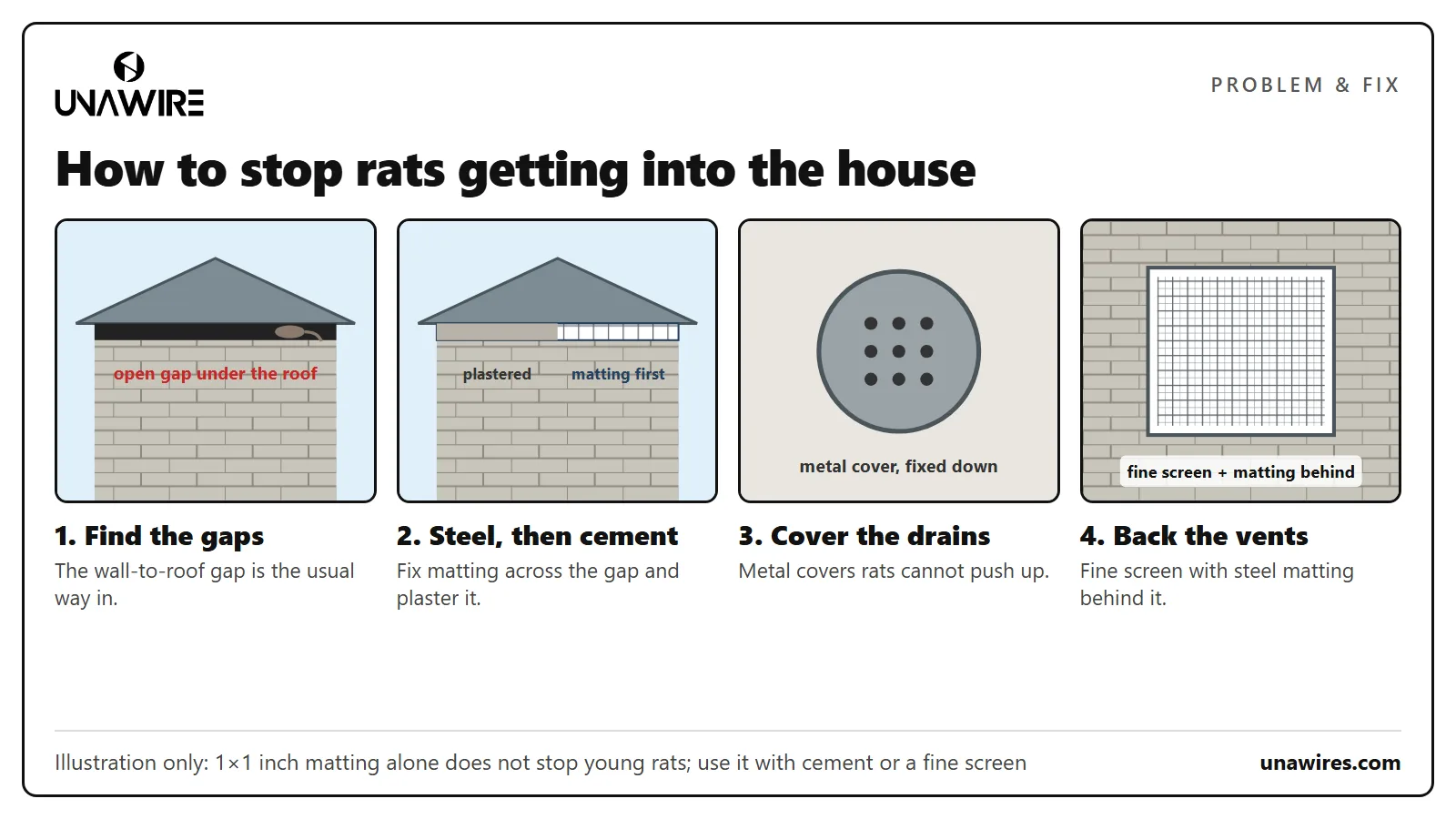
Find every gap rats use: the opening between the top of the wall and the roof, holes into the ceiling, floor drains, vents, pipe holes and gaps under doors. Then close them with something rats cannot chew. Rats bite through wood, plywood, plastic screen, foam and thin wire. They cannot bite through steel matting or cement. For a lasting seal, fix steel matting across the gap and plaster over it, so the opening is closed solid. Traps and poison deal with the rats already inside; sealing is what stops new ones.
If you hear running in the ceiling at night (may daga sa kisame), rats have already found a way in. Traps and poison help, but new rats keep coming through the same holes. The long-term fix is to close the holes, and to close them with materials a rat's teeth cannot get through. This guide shows where rats usually enter a Philippine house, what to seal each gap with, and where steel matting fits in.
First, the Honest Part: How Small a Gap Rats Use
Rats squeeze through much smaller holes than their bodies look. A young rat can get through a gap about the width of your thumb, and mice through even less. That matters for choosing the right material:
- Steel matting on its own is not a rat screen. Our smallest mesh is 1×1 inch (about 25 mm), and a young rat can pass through that. We do not sell it as rat-proof mesh by itself.
- What steel matting does well is reinforce a solid seal. Fixed across a gap and plastered over, it gives the cement something to grip and stops the patch from cracking and falling out, so the hole is closed for good.
- It also backs up finer screens. Rats tear and chew fine screens. Steel matting behind the screen takes the force, so the screen stays in place.
Where Rats Get Into a House, and How to Close Each Gap
1. The gap between the top of the wall and the roof
This is the main entry in many Philippine houses. Hollow block walls stop below the roof sheets, leaving an open strip along the eaves where the roofing goes up and down in waves. Rats climb the wall, a tree, or electric and cable wires and walk straight in. Seal it: close the strip with cement or a block course up to the roof where possible. Where the gap is too uneven, fix a strip of steel matting across it, tie it to the purlins or wall, and plaster both sides so the gap is filled solid. Where you need airflow, use a fine galvanized screen with steel matting behind it.
2. Holes into the ceiling
Rats chew through plywood or fiber-cement ceiling boards at the edges and around ceiling access holes and light fittings. Seal it: repair the board, and in the space above, block the routes from the eaves first. For an access hatch, a steel matting backing behind the cover makes it hard to chew through.
3. Floor drains, sinks and bathroom drains
Rats come up through drains connected to the canal or septic line. Seal it: use a strong metal drain cover with small holes, screwed or set in cement so it cannot be pushed up. For an open canal or a large drain at the yard, see the drain cover ideas.
4. Vents, exhaust fans and air conditioner holes
Any wall opening is an entry, especially old exhaust fan or aircon holes left open. Seal it: close unused holes with cement. For a vent you need to keep open, fit a fine galvanized screen and fix steel matting behind it, held with screws or anchors, not tape or glue.
5. Holes around pipes and cables
Pipes for water and drainage, and cables for power and internet, often go through a hole bigger than the pipe. Seal it: fill around the pipe with cement or a hard filler. Foam alone gets chewed out.
6. Gaps under doors
A gap you can slide a finger under is enough for a young rat. Seal it: fit a metal door sweep or raise the threshold. A kitchen door to the yard is the one to check first.
7. Burrows under the ground floor
Rats dig under ground-floor slabs and come up through cracks or an unsealed edge. Seal it: repair the slab, and around the outside edge, pour a reinforced concrete strip or apron so rats cannot dig in along the wall. Steel matting inside that strip keeps it from cracking. See steel matting for a floor slab.
What Rats Can and Cannot Chew Through
| Material | Stops rats? | Notes |
|---|---|---|
| Expanding foam, plastic, rubber | No | Chewed through quickly |
| Wood, plywood, fiber-cement board | No | Chewed at edges and corners |
| Plastic or nylon screen | No | Torn and chewed |
| Thin wire such as chicken wire | Not reliably | Thin wire can be bitten or pushed open, and the openings are large |
| Steel matting alone | Not for small rats | Steel cannot be chewed, but 1×1 inch openings are big enough for a young rat |
| Steel matting plastered with cement | Yes | Solid seal that does not crack and fall out |
| Fine metal screen with steel matting behind | Yes, if fixed well | Keeps airflow; matting stops the screen from being pushed in |
Which Steel Matting for Rat-Proofing
| Job | Mesh | Wire | Finish |
|---|---|---|---|
| Backing for cement or plaster in a wall-to-roof gap | 1×1 or 2×2 inch | 2.6 – 3.0 mm | Black iron (covered by cement) |
| Backing behind a fine screen on a vent | 1×1 inch | 2.6 mm | Galvanized (exposed to air and rain) |
| Concrete strip or apron along the wall | 2×2 inch | 3.0 – 3.5 mm | Black iron |
Prices from our October 2026 price list, per 4×8 ft sheet: 1×1 inch black iron from ₱1,250, 2×2 inch black iron 2.6 mm ₱318 and 3.0 mm ₱450. A single 4×8 ft sheet cut into strips covers a long run of eave gap. Galvanized 1×1 inch is a separate product; ask for a quote. See the price list.
Tips
- Seal first, then trap. If you only trap, new rats keep using the same holes.
- Look for signs at night. Droppings, grease marks along walls and chewed edges show you the routes.
- Cut back branches and wires. Trees touching the roof and cables running to the eaves are rat bridges.
- Keep food and garbage closed. A house with no easy food is less attractive even before every hole is sealed.
- Work safely. Wear gloves and a mask when you clean droppings, and use a proper ladder or a contractor for roof work.
Frequently Asked Questions
How do I stop rats from entering my house?
Find the gaps rats use, mainly the gap between the wall and the roof, ceiling holes, drains, vents, pipe holes and gaps under doors, and close them with materials rats cannot chew, such as cement, metal and steel matting plastered over. Then trap the rats already inside.
Can rats chew through steel matting?
No, rats cannot chew through steel wire. But the openings in steel matting, even 1×1 inch, are large enough for a young rat to squeeze through, so use it as backing for cement or behind a fine metal screen, not as a rat screen on its own.
Is chicken wire rat-proof?
Not reliably. The wire is thin and the openings are large, so rats can push through or bite it. Cement, or a fine metal screen backed with steel matting, makes a stronger seal.
How do I close the gap between the wall and the roof?
Close it with cement or a block course where you can. Where the gap is uneven, fix a strip of steel matting across it, tie it to the wall or purlins, and plaster over it. Use a fine galvanized screen with matting behind it where you need ventilation.
What is the best mesh for rat-proofing a vent?
A fine galvanized metal screen with small openings, with 1×1 inch galvanized steel matting fixed behind it so the screen cannot be torn or pushed in. Fix it with screws or anchors, not glue or tape.
See also window grille ideas, drain cover ideas, all the uses of steel matting and the price list.
Problem guides: pigeons under solar panels and rats and snakes in the chicken coop.
Tell us the gaps, we cut the matting
Send us the length of the eave gap or the size of each opening and your delivery address. We will tell you how many sheets you need and the price. Ask us about custom sizes if standard sheets do not fit.
Get a Free Quote →