
What steel matting is used for a concrete floor slab?
For a house floor slab on the ground, use 2×2 inch black iron steel matting, 3.0 to 3.5 mm wire, in 4×8 ft or 6×20 ft sheets. Go up to 4.5 mm for garages, shops and heavier floors. Hold the mesh in the slab on wire chairs, lap sheets and tie them with GI wire. Our October 2026 pick-up price for 3.5 mm is ₱534 per 4×8 sheet and ₱1,871 per 6×20 sheet. Always confirm gauge, slab thickness and any elevated or structural slab with your engineer.
If you are building a house, shop or small warehouse, the floor slab is where steel matting is used most. This page explains which mesh and wire thickness suit each kind of floor, where the mesh sits in the slab, and how many sheets and what size to order. For the general guide to wire mesh in concrete, see wire mesh for concrete reinforcement.
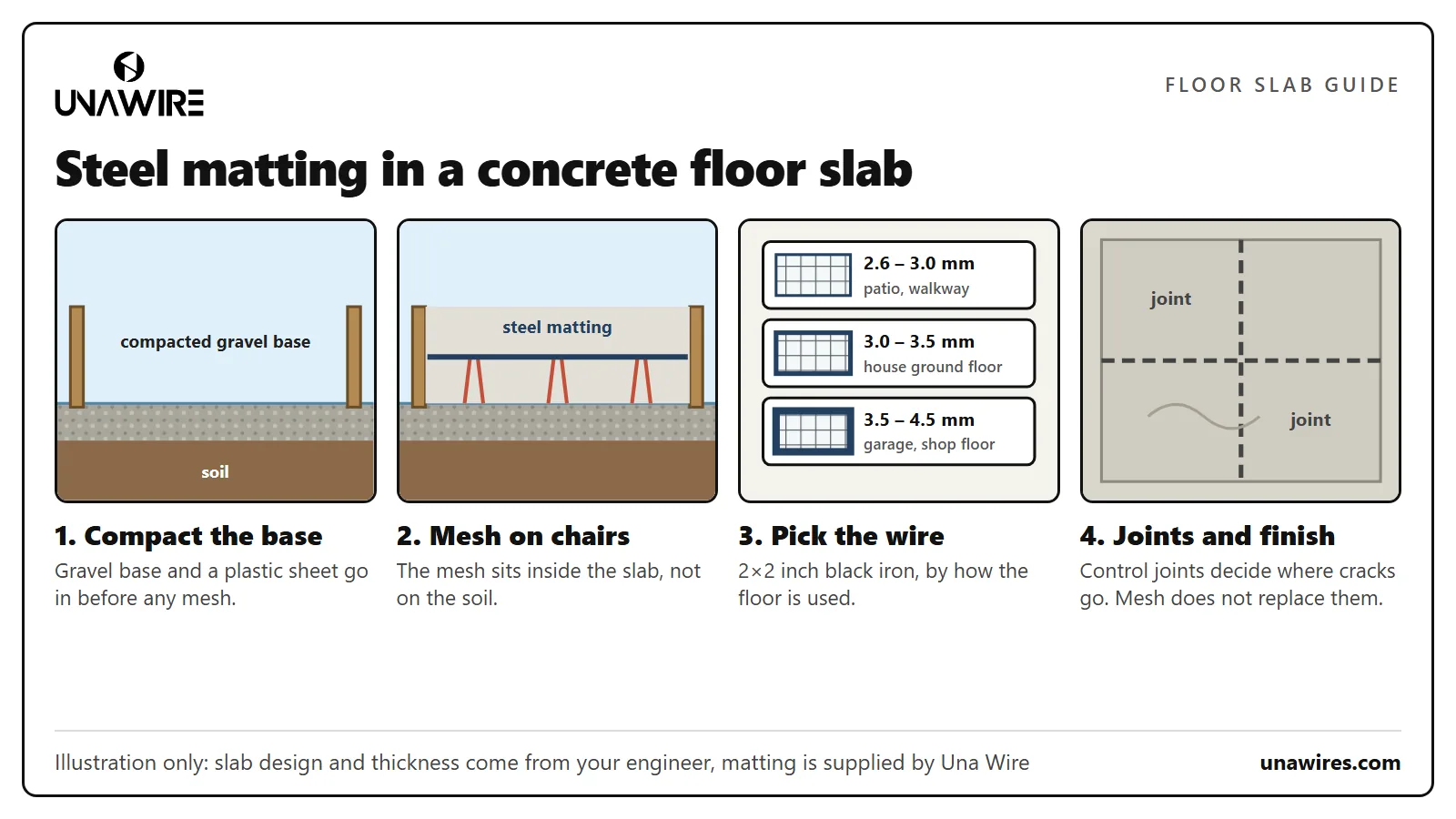
Which Steel Matting for Which Floor?
| Floor | Mesh opening | Wire | Usual slab thickness | Notes |
|---|---|---|---|---|
| Walkway, patio, light floor | 2×2 inch | 2.6 – 3.0 mm | 75 mm | Light use only |
| House ground-floor slab | 2×2 inch | 3.0 – 3.5 mm | 75 – 100 mm | The common residential spec |
| Garage, carport | 2×2 inch | 3.5 – 4.5 mm | 100 – 125 mm | See the driveway page |
| Shop, store or commercial floor | 2×2 inch | 3.5 – 4.5 mm | 100 mm and up | Confirm with your engineer |
| Warehouse or industrial floor | 2×2 inch | 4.5 – 6.0 mm | Per design | Forklift or heavy racks: engineer decides |
These are common practice figures, not a design. The slab thickness, wire and any second layer come from your engineer. See the thickness chart for the wire sizes we make.
What the Mesh Does in a Floor Slab
Concrete is strong when pressed and weak when stretched. Steel matting is a grid of wires welded at every crossing, so it spreads the stretching force across the slab and holds hairline cracks tight. In a slab on the ground this crack control is the job of the mesh. Columns, beams, footings and elevated slabs carry load in a different way and use deformed bars set by your engineer. We compare the two in steel matting vs deformed bar.
What Goes Under and Around the Mesh
- Compacted sub-base. Compact the soil and a layer of gravel or crushed base first. A slab on loose fill settles and cracks, and no mesh fixes that.
- Plastic sheet. Many builders lay a polyethylene sheet over the base to keep soil moisture out of the slab.
- Chairs. Wire or plastic chairs hold the mesh up inside the slab. About 40 to 50 mm high for a 100 mm slab.
- Cover. Keep the wire at least 20 mm from the surface. The install guide has the steps.
- Joints. Cut or form control joints so the slab cracks where you want it to. Mesh does not replace joints.
4×8 ft or 6×20 ft Sheets?
A 4×8 ft sheet (1.22 × 2.44 m) is easy to carry and suits rooms, small houses and tight spaces. A 6×20 ft sheet (1.83 × 6 m) covers about four times the area, so a big floor needs fewer laps. For a floor over about 50 m² the 6×20 is usually the better buy. Work out your sheet count and budget on the slab cost page or with the quantity guide.
Black Iron or Galvanized for a Slab?
Black iron. The concrete protects mesh that it fully covers, so galvanizing adds cost you do not need inside a slab. Galvanized is for mesh that stays exposed, such as drain covers or fences. See galvanized vs black iron.
Common Floor Slab Mistakes
- Mesh lying on the soil. Use chairs. Mesh that sits on the ground does very little.
- No laps, or a bare edge to edge joint. Overlap sheets and tie them.
- Mesh walked flat during the pour. Lay boards to walk on so the chairs do not get pushed over.
- Wire too light for the load. A 2.6 mm sheet is fine for a patio and not for a garage.
- No joints. A large slab without control joints will crack somewhere, mesh or not.
Frequently Asked Questions
What steel matting do I use for a house floor slab?
For a ground-floor slab, 2×2 inch black iron steel matting in 3.0 to 3.5 mm wire is the common choice, in 4×8 ft or 6×20 ft sheets. Use 4.5 mm for garages, shops and heavier floors. Always confirm gauge, slab thickness and any elevated or structural slab with your engineer.
Should the mesh sit on the ground or in the middle of the slab?
Hold it in the slab on wire chairs, not flat on the soil. Mesh that is pressed to the ground does very little once the concrete is poured. See the install guide for chair heights.
Can steel matting replace rebar in a floor slab?
For a slab on the ground it is often used as the slab reinforcement. For columns, beams, footings and elevated slabs, your engineer specifies deformed bars. See steel matting vs deformed bar.
Do I need galvanized steel matting for a floor slab?
No. Black iron is normal for mesh that is fully covered by concrete. Galvanized costs more and is for mesh that stays exposed.
Will steel matting stop my slab from cracking?
It holds fine cracks tight so they do not open up. It does not remove cracking. Good sub-base preparation, a sensible slab thickness and control joints matter just as much.
See also steel matting for a driveway, weight per sheet, sizes and the price list.
Send us your floor area, we quote the sheets
Tell us the area in square meters, the room or floor type, the sheet size you prefer and your delivery address. We will reply with the sheet count, the price and what is in stock.
Get a Free Quote →