
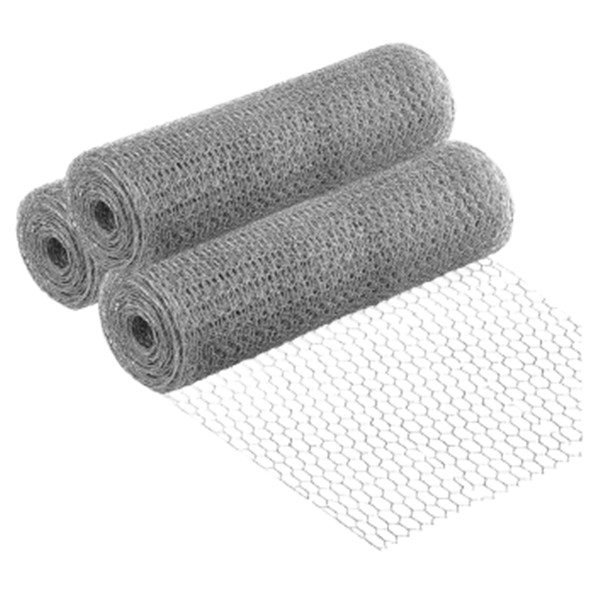
What is chicken wire and how much does it cost?
Chicken wire (poultry netting, hexagonal wire mesh) is lightweight galvanized wire twisted into hexagonal cells, flexible enough to bend and shape by hand. Una Wire Products supplies it factory-direct in Quezon City, per 90 ft roll: ₱1,600 (4 ft), ₱1,900 (5 ft), and ₱2,300 (6 ft). Prices current as of September 2026.
What is Chicken Wire?
Chicken wire — also known as poultry netting or hexagonal wire mesh — is made from thin galvanized steel wire twisted into a repeating pattern of six-sided (hexagonal) cells. Unlike welded wire, which is fused at each junction, chicken wire is formed by twisting adjacent wires around each other at each intersection. The result is a lightweight, flexible mesh that can be bent, curved, and shaped by hand without tools, making it one of the easiest wire products to install.
Locally, it is commonly called "manok na wire" (literally "chicken wire"), "hex wire," or simply chicken wire. You will find it in backyard farms across the provinces, urban community gardens in Metro Manila, and on construction sites where it serves as a plaster base for cement rendering.
All chicken wire supplied by Una Wire Products is galvanized — the wire strands carry a zinc coating that protects the steel against rust and corrosion. In the Philippine climate, where humidity is consistently high and rainfall frequent, uncoated wire deteriorates rapidly when used outdoors. The galvanized finish significantly extends the useful life of the mesh, particularly in the wet environments typical of poultry houses, garden beds, and outdoor enclosures.
Chicken Wire Price List (2026)
We supply galvanized chicken wire factory-direct from Quezon City, priced per 90 ft roll by roll height.
| Roll Height | Price per Roll (90 ft) |
|---|---|
| 4 ft (1.2 m) | ₱1,600 |
| 5 ft (1.5 m) | ₱1,900 |
| 6 ft (1.8 m) | ₱2,300 |
Prices are per 90 ft roll, factory-direct, as of September 2026 and subject to change with steel market conditions. Bulk/contractor pricing available for orders of 10+ rolls — contact us for a quote.
Chicken Wire Specifications
We supply galvanized chicken wire in three roll heights — 4 ft, 5 ft and 6 ft. Every roll has the same specification; only the height differs.
| Wire Gauge | Hex Opening Size | Roll Height | Roll Length | Coating |
|---|---|---|---|---|
| G.I. 0.70 mm (#22) | 1 × 1 inch (fine hex) | 4 ft (1.2 m) | 90 ft (~27 m) | Galvanized |
| G.I. 0.70 mm (#22) | 1 × 1 inch (fine hex) | 5 ft (1.5 m) | 90 ft (~27 m) | Galvanized |
| G.I. 0.70 mm (#22) | 1 × 1 inch (fine hex) | 6 ft (1.8 m) | 90 ft (~27 m) | Galvanized |
Contact us to confirm current stock and your quantity requirements.
Common Uses in the Philippines
Chicken wire is one of the most versatile and affordable wire products available, with a wide range of uses across agriculture, construction, and everyday life in the Philippines:
- Poultry and backyard chicken coops. The original and most common use — chicken wire gets its name from this application. It is the standard enclosure material for backyard chicken farms, gamefowl ranges, and free-range poultry areas across the country. The 1-inch hex opening keeps chickens in and most predators out, while the lightweight design makes it easy to build and reconfigure enclosures as needed.
- Rabbit and small animal enclosures. The 1-inch fine hex mesh is well suited to rabbit hutches, guinea pig pens, and other small animal enclosures where a smaller opening is needed to prevent escape and protect against cats, rats, and other small predators. The galvanized coating holds up to the damp conditions typical of animal housing.
- Garden and vegetable bed protection. Chicken wire is widely used to protect vegetable beds, seedling areas, and fruit crops from birds, rats, and stray animals. A simple frame of bamboo or light steel pipe covered with chicken wire creates an effective low-cost garden protector that lets in light and rain while keeping pests out.
- Plant support and trellis. The flexible hexagonal structure of chicken wire makes it an excellent climbing plant support. Pechay, sitaw (string beans), ampalaya (bitter melon), and other vining crops can be trained to grow along a chicken wire trellis, keeping plants upright and improving air circulation and yield.
- Plastering base (stucco netting). Chicken wire is widely used in construction as a substrate for cement plaster — commonly called "stucco netting" or plaster mesh. Stapled or wired to a wood or steel frame, it gives the plaster a mechanical key to grip, preventing cracking and delamination on lightweight partition walls, exterior finishes, and decorative concrete work.
- Arts, crafts, and school projects. The pliable, easy-to-cut nature of chicken wire makes it a popular material for school projects, DIY crafts, sculpture armatures, and decorative installations. It can be shaped into three-dimensional forms by hand, making it accessible for non-professional users without specialized tools.
Why Galvanized Chicken Wire Lasts Longer in the Philippines
The Philippine climate is one of the most demanding environments for outdoor metal products. Average humidity across the archipelago stays above 70% year-round, rising to 85–95% in coastal areas and during the wet season. Rainfall is frequent and heavy across most regions, and UV exposure at tropical latitudes is intense. Together, these conditions accelerate corrosion of unprotected steel at a rate several times faster than in temperate climates.
Uncoated or poorly galvanized chicken wire will begin to show surface rust within weeks of outdoor installation in these conditions. Within one to two wet seasons, the wire strands can corrode enough to weaken significantly — leading to mesh failure, animal escapes, and the cost and effort of replacement. A poultry enclosure built from poor-quality wire that needs replacing every year is far more expensive over time than one built with properly galvanized mesh from the start.
The zinc coating on Una Wire's chicken wire acts as a sacrificial barrier — even if the surface is scratched or the wire is in contact with damp soil, the zinc continues to protect the underlying steel through a process called cathodic protection. This means the wire remains structurally sound and visually acceptable for significantly longer, even in the wet, sun-exposed conditions typical of Philippine farm and garden environments.
Chicken Wire vs. Welded Wire — Which is Right for You?
Both chicken wire and welded wire are used for enclosures and fencing, and buyers often ask which one to choose. The answer depends primarily on the size of the animals involved, the level of structural rigidity needed, and the budget available.
| Feature | Chicken Wire | Welded Wire |
|---|---|---|
| Strength | Lower — thin wire, twisted (not welded) joints | Higher — thicker wire, rigid welded junctions |
| Flexibility | Very flexible — easy to bend, shape, and wrap around curves | Rigid — holds a flat plane, harder to curve or shape |
| Best Animal Size | Small — chickens, rabbits, birds, small rodents | Small to medium — poultry, hogs, dogs, goats |
| Ease of Install | Very easy — can be cut and shaped by hand with basic tools | Moderate — heavier and more rigid, requires wire cutters and staples |
| Price Point | Lower cost per roll | Higher cost, but more durable under pressure |
| Common Use | Chicken coops, garden guards, plant trellises, plaster base | Hog pens, dog kennels, animal cages, window guards, concrete reinforcement |
For heavier animals or enclosures that must resist significant pressure, welded wire is the better choice. View our Welded Wire product page →
Why Buy Chicken Wire from Una Wire?
- Consistent hex pattern and gauge. Every roll we produce maintains uniform hexagonal cell dimensions and consistent wire gauge throughout. Irregular openings and varying wire thickness — common in low-quality imports — mean inconsistent strength and appearance. Our manufacturing process holds dimensional tolerances tightly across every roll.
- Manufacturer-direct pricing. We produce chicken wire at our Quezon City plant and sell direct. There is no distributor in the supply chain adding markup — you pay factory prices whether you are buying a single roll for a backyard coop or a hundred rolls for a large farm project.
- Available per roll and in bulk. We supply single rolls for small projects and full pallet quantities for large farm, landscaping, or construction contracts. Contact our sales team to discuss volume pricing for bulk orders.
Frequently Asked Questions
What is chicken wire called in the Philippines?
Chicken wire is commonly called 'manok na wire' or 'hex wire' in the Philippines, referring to its hexagonal mesh pattern. It is also known as poultry netting. In hardware stores it is often labeled as 'chicken wire' in English, and it is one of the most widely available wire mesh products in the country.
What gauges and sizes of chicken wire are available?
Una Wire Products supplies chicken wire in one gauge, #22 (0.70 mm), with a 1×1 inch hex opening, in 4 ft, 5 ft and 6 ft roll heights. Each roll is 90 ft (approximately 27 meters). The galvanized zinc coating protects against rust in the Philippines' humid climate.
How much is chicken wire per roll?
As of September 2026, Una Wire Products' factory-direct price per 90 ft roll is ₱1,600 for 4 ft, ₱1,900 for 5 ft and ₱2,300 for 6 ft. Bulk pricing is available for orders of 10+ rolls — call (02) 8260-0181.
Is chicken wire strong enough for rabbit and small animal enclosures?
Chicken wire is suitable for enclosing chickens, ducks, and small garden animals, but for rabbits or areas with larger predators, a heavier welded wire mesh is recommended. Rabbits can chew through lighter chicken wire (#22 gauge), and larger animals can push through the hexagonal openings. For secure rabbit hutches, use #16 gauge welded wire with 1-inch openings.
Can chicken wire be used as a plaster or stucco base on walls?
Yes. Chicken wire is widely used in the Philippines as a lath substrate for cement plaster and stucco on walls, especially over irregular surfaces or lightweight block. The hexagonal mesh provides a mechanical key for mortar to grip. It is also used as reinforcement in sculptural concrete work and garden ornaments.
How long does galvanized chicken wire last outdoors in the Philippines?
Galvanized chicken wire from Una Wire Products is designed for outdoor use in the Philippine climate. The zinc coating provides cathodic protection against rust. With proper installation (kept off the ground where possible), galvanized chicken wire typically lasts 10–15 years outdoors in Philippine conditions. Coastal or highly humid environments may experience faster zinc depletion.
How to Order
Getting chicken wire from Una Wire is simple. Here are the three steps:
- Call us or submit the quote form. Reach us at (02) 8260-0181 or use the contact form on this page. Let us know the roll height and quantity you need.
- Confirm specifications and quantity. We will confirm available stock, current pricing, and lead time based on your requirements. For large or custom orders, our team will advise on scheduling.
- Arrange delivery or Quezon City pickup. We deliver to Metro Manila and nearby provinces, or you can pick up directly from our factory in Balingasa, Quezon City at a time that works for your project.
Or call us directly: (02) 8260-0181 · +63 922 857 7288
We deliver to: Quezon City · Manila · Caloocan · Pasig · Valenzuela · Malabon · Mandaluyong · Marikina · Rizal (incl. Antipolo) · Bulacan · Cavite · Laguna · Pampanga · Nueva Vizcaya · Cebu · Iloilo · Davao.