
How do you stop pigeons getting under solar panels?
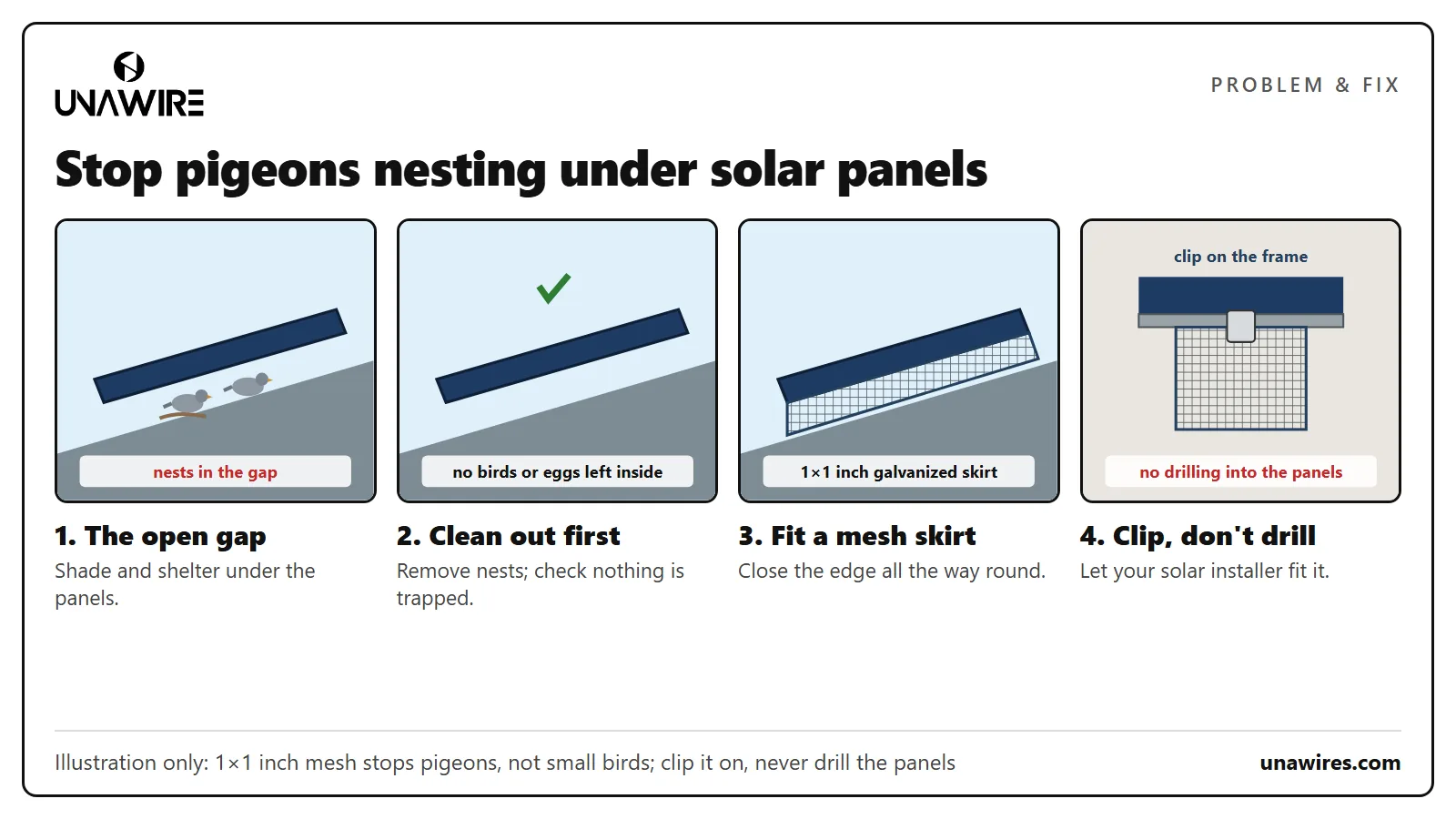
Close the gap between the edge of the panels and the roof with a mesh skirt: strips of 1×1 inch galvanized steel matting fixed around the whole array, clipped to the panel frame at the top and resting on the roof at the bottom. First clean out the nests and droppings and make sure no birds are trapped inside. Use clips made for solar panels and do not drill into the panels; ask your solar installer to fit it. 1×1 inch mesh keeps pigeons out, but smaller birds such as maya can pass through it.
The shaded, sheltered gap under rooftop solar panels is a favourite nesting spot for pigeons. Nests, feathers and droppings pile up on the roof and around the wiring, the noise starts at dawn, and droppings stain the panels and gutters. Scaring them away rarely lasts, because the space is still there. The lasting fix is to close the gap around the edge of the array so birds cannot get under. This guide covers how a mesh skirt works, which mesh to use, how to fit it safely, and what it costs.
Why Pigeons Nest Under Solar Panels
- Shelter. The panels shade the roof and keep off rain, like a ready-made roof over a nest.
- Safety. Cats and birds of prey cannot reach them easily under a low panel.
- An open edge. Most arrays leave a gap of several centimetres to more than 20 cm between the panel edge and the roof all the way round.
- Habit. Once a pair nests, they come back, and others follow.
How to Fix It in 5 Steps
1. Clean out the space first
Remove nests, sticks and droppings from under the panels. Check carefully that no birds, chicks or eggs are left inside before you close the gap, so nothing is trapped. Wear gloves and a mask when handling droppings.
2. Measure the gap and the perimeter
Walk round the array and measure the total length of open edge, and the height of the gap at its tallest point. The mesh strip should be a little taller than the tallest gap so it can rest on the roof.
3. Cut the matting into strips
Cut 1×1 inch galvanized steel matting into strips the height of the gap plus a few centimetres. A 4×8 ft sheet cut lengthwise into six strips gives strips about 20 cm high and 2.44 m long, which is about 14.6 m of skirt per sheet (calculated). Bend the bottom edge slightly so it sits flat on the roof.
4. Clip it to the panel frame, not the panel
Fix the top of each strip to the aluminium frame of the panels with clips made for solar mesh. Do not drill into the panels or the frame. Drilling can damage the panel and may affect its warranty. The bottom of the strip rests on the roof and is not fixed through the roof sheet.
5. Overlap the strips and close the corners
Overlap neighbouring strips by at least one mesh opening and tie them with GI wire, and fold the mesh around the corners so there is no gap. Check after a week that the birds are not getting in anywhere.
Which Mesh to Use
| Option | Keeps out pigeons? | Notes |
|---|---|---|
| 1×1 inch galvanized steel matting | Yes | Rigid, holds its shape in the wind, galvanized for the roof. Our recommended option. |
| 2×2 inch steel matting | Not reliably | The 2 inch openings are big enough for a pigeon to squeeze through. |
| Chicken wire | For a while | Thin wire sags, rusts on a hot roof and is easily pushed open. |
| Plastic netting | For a while | Degrades in the sun and can be pecked and torn. |
Honest limit: 1×1 inch (about 25 mm) openings keep pigeons out, but small birds such as maya (sparrows) can pass through them. If small birds are the problem, you need a finer mesh than we make; ask your solar installer.
What It Costs
Galvanized 1×1 inch steel matting (G.I. #12 to #10) is ₱2,850 to ₱3,750 per 4×8 ft sheet on our October 2026 price list. Cut into 20 cm strips, one sheet covers about 14.6 m of panel edge.
| Edge to cover | Sheets (20 cm strips, with laps) | Matting cost |
|---|---|---|
| Up to about 12 m (a small home array) | 1 | ₱2,850 – ₱3,750 |
| Up to about 25 m | 2 | ₱5,700 – ₱7,500 |
| Up to about 38 m | 3 | ₱8,550 – ₱11,250 |
Matting only, before clips, tie wire, delivery and installation. Sheet counts allow about 15% for laps and corners; taller gaps need wider strips and more sheets. See the price list.
Safety
- Let your solar installer fit it. They know the panel frames, the wiring and the warranty terms.
- Roof work is dangerous. Use a proper ladder, a harness on steep or high roofs, and do not walk on the panels.
- Keep the mesh clear of wiring. The skirt closes the edge; it should not press on cables or connectors.
- Cover sharp edges. Cut wire ends can scratch hands and cable insulation; bend them inward.
Frequently Asked Questions
How do I stop pigeons nesting under my solar panels?
Clean out the nests, check that no birds or eggs are left inside, then close the gap around the edge of the array with a mesh skirt: strips of 1×1 inch galvanized steel matting clipped to the panel frame and resting on the roof.
What size mesh keeps pigeons out of solar panels?
1×1 inch (about 25 mm) mesh keeps pigeons out. 2×2 inch openings are too big. Smaller birds such as maya can pass through 1×1 inch, so they need a finer mesh.
Will a mesh skirt damage my solar panels?
Not if it is clipped to the panel frame with clips made for the job and nothing is drilled into the panels or frame. Ask your solar installer to fit it so the warranty and wiring are looked after.
Why not use chicken wire under solar panels?
It works for a while, but the thin wire sags, rusts in the heat on a roof and is easily pushed open. Galvanized steel matting is rigid and holds its shape.
How much does it cost to bird-proof solar panels?
The matting for about 12 m of panel edge is one 4×8 ft sheet of 1×1 inch galvanized steel matting, ₱2,850 to ₱3,750 on our October 2026 price list. Clips and installation are extra.
See also how to stop rats entering the house, galvanized vs black iron, all the uses of steel matting and the price list.
Send us the length of panel edge
Tell us the total length of edge to cover, the height of the gap and your delivery address. We will reply with the number of sheets and the price. Ask about custom sizes for large installations.
Get a Free Quote →