
Why does wire mesh end up at the bottom of a concrete slab, and how do you stop it?
Because it was laid on the soil, or "hooked up" during the pour and then stepped back down. Mesh at the bottom does little to keep the slab's cracks tight, and with no concrete under it, it can rust. Set the mesh on chairs or spacers (about 40 to 50 mm high for a 100 mm slab), space them so the sheet does not sag, tie the mesh to them, lay boards to walk on, and check the height just before and during the pour.
It is one of the most common things we hear from homeowners: the floor cracked even though steel matting was used, and the photos from the pour show the mesh lying on the soil. Steel matting only works when it sits inside the concrete. This page explains why mesh ends up at the bottom, why that matters, and a simple routine to keep it in place, from setting the chairs to the last bucket of concrete.
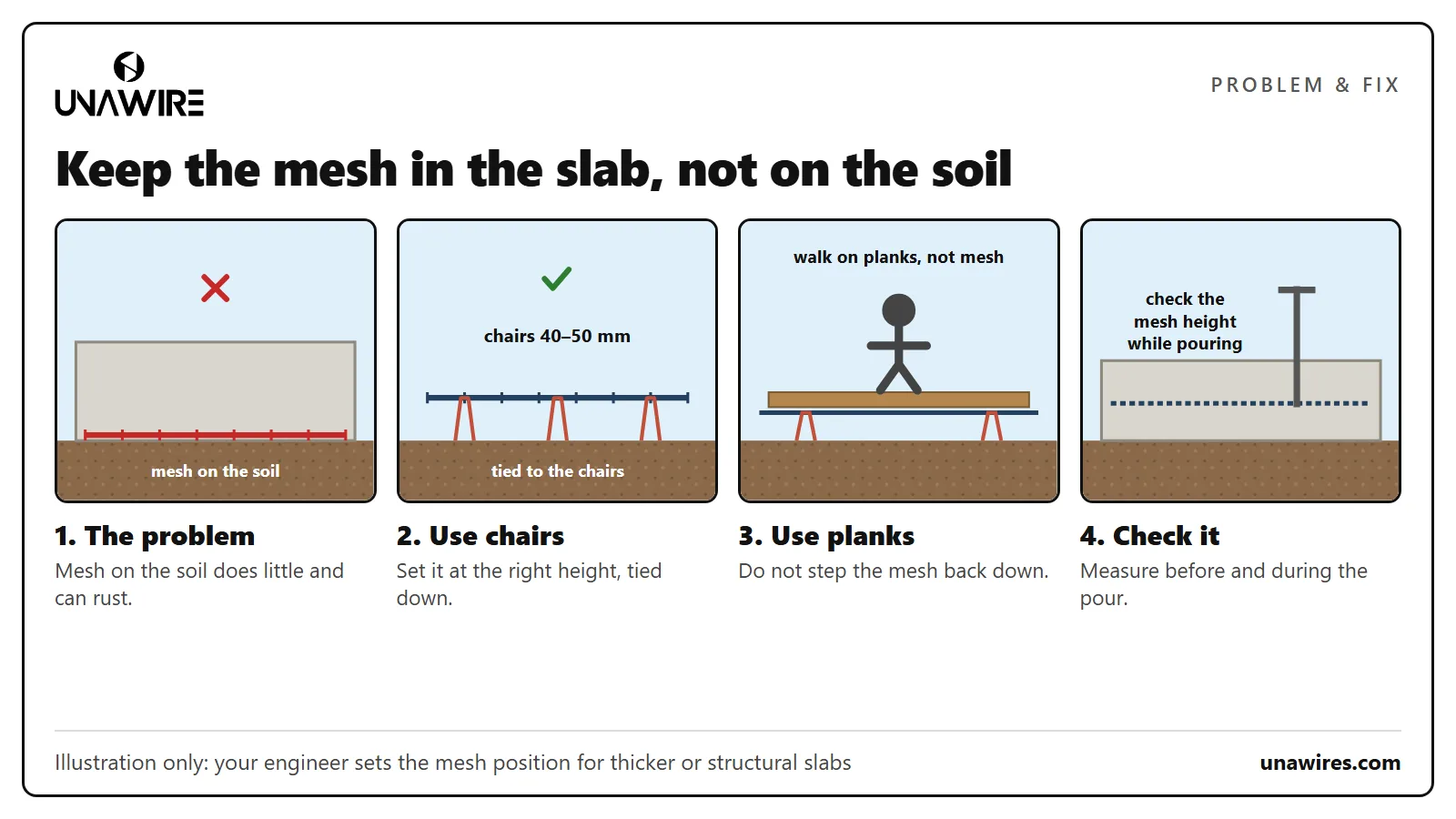
Why Mesh at the Bottom Is a Problem
- It does little where cracks start. Shrinkage cracks open at the top of the slab. Mesh lying on the soil is too far down to hold them tight.
- It can rust. Mesh in contact with wet soil has no concrete around it to protect it. Rust swells and can crack the concrete from inside.
- You paid for steel that is not working. The mesh cost is the same either way. Keeping it in place costs a few chairs and some care.
Why Mesh Ends Up at the Bottom
| Cause | What happens | Fix |
|---|---|---|
| Laid straight on the soil | Nothing lifts it; it stays at the bottom | Chairs or spacers under every sheet |
| "Hooking up" during the pour | Workers lift it with a hook, then step it back down | Use chairs instead; do not rely on hooking |
| Workers walk on the mesh | Their weight pushes it and the chairs down | Lay planks across and walk only on them |
| Chairs too far apart | The sheet sags between chairs | Add chairs until the sheet stays flat |
| Stones or broken concrete as spacers | They roll, sink or crumble | Proper wire chairs or plastic spacers |
| Mesh not tied | It slides off the chairs when concrete hits it | Tie laps and tie the mesh to the chairs with GI wire |
| Very light wire on a wide span | Thin wire bends more under foot and concrete | Closer chairs, or a heavier gauge |
How to Keep the Mesh in Place: 6 Steps
1. Use real chairs or spacers
Wire chairs or plastic spacers, about 40 to 50 mm high for a 100 mm slab, so the mesh sits in the slab with at least 20 mm of concrete over it. Concrete blocks made for the purpose also work. Stones and broken hollow blocks do not.
2. Space them so the sheet does not sag
Set chairs in rows under each sheet and at every lap. Press the mesh midway between two chairs: if it dips, add a chair. Thinner wire (2.6 to 3.0 mm) needs them closer than 3.5 to 4.5 mm wire.
3. Tie everything
Lap sheets by at least one mesh opening (150 mm is common) and tie the laps with GI wire. Tie the mesh to the chairs at intervals so it cannot slide off when the concrete is dumped on it. See tie wire per roll.
4. Lay walking boards
Put planks across the mesh, resting on the chairs, before anyone walks in with concrete. Move the boards as the pour goes on. This one step prevents most of the problem.
5. Check just before the pour
Walk the area and measure the mesh height at several points with a ruler from the base. Fix any spot that is too low, has a missing chair or an untied lap.
6. Check during the pour
Have one person watch the mesh as concrete goes in and push a rod in near the edge to feel the mesh height. Lift and re-seat any chair that has been knocked over before that area is covered.
Does the Gauge or Sheet Size Help?
Yes. Heavier wire (3.5 to 4.5 mm) is stiffer and sags less between chairs than 2.6 to 3.0 mm, and 6×20 ft sheets mean fewer laps to tie and fewer edges to step on than 4×8 ft sheets. For a house floor, 2×2 inch matting is common at 3.0 to 3.5 mm, and at 3.5 to 4.5 mm for a carport or driveway. Always confirm gauge, slab thickness and any elevated or structural slab with your engineer.
| 2×2 inch black iron | 4×8 ft sheet | 6×20 ft sheet |
|---|---|---|
| 3.5 mm | ₱534 | ₱1,871 |
| 4.5 mm | ₱803 | ₱2,910 |
October 2026 pick-up prices per sheet. All gauges are on the price list.
What If the Slab Is Already Poured?
You cannot move the mesh after the concrete sets. If you are worried, ask your engineer: they can check the slab and tell you whether it needs anything. In a ground floor slab, low mesh usually shows up as cracks that open wider over time, and your engineer can tell you whether sealing them is enough. For an elevated or structural slab, do not guess, have an engineer look at it.
Frequently Asked Questions
Should wire mesh be at the bottom of a concrete slab?
No. Steel matting in a ground slab should sit inside the concrete on chairs, with at least 20 mm of concrete cover, not on the soil. At the bottom it does little to hold cracks and can rust.
Is it OK to hook the wire mesh up during the pour?
It is not reliable. Mesh lifted with a hook is often stepped back down as workers move, so it ends up low anyway. Chairs or spacers hold it at a fixed height.
How high should steel matting be in a slab?
For a 100 mm ground slab, chairs about 40 to 50 mm high are common, with at least 20 mm of concrete over the mesh. Your engineer sets the position for thicker or structural slabs.
What can I use instead of chairs for wire mesh?
Plastic spacers or small concrete blocks made for the job. Do not use stones or broken hollow blocks; they roll, sink or crumble under the weight of workers and concrete.
How do I stop workers stepping the mesh down?
Lay planks across the mesh resting on the chairs and walk only on them, tie the mesh to the chairs, and have one person check and re-seat the mesh during the pour.
See also how to install steel matting in a slab, why concrete floors crack, steel matting for a floor slab and weight per sheet.
Get the right matting for your slab
Tell us the slab size, the wire thickness your engineer or contractor specified, and your delivery address. We will reply with the sheet count and price, with tie wire if you need it.
Get a Free Quote →