
Why does the plaster on a hollow block wall crack?
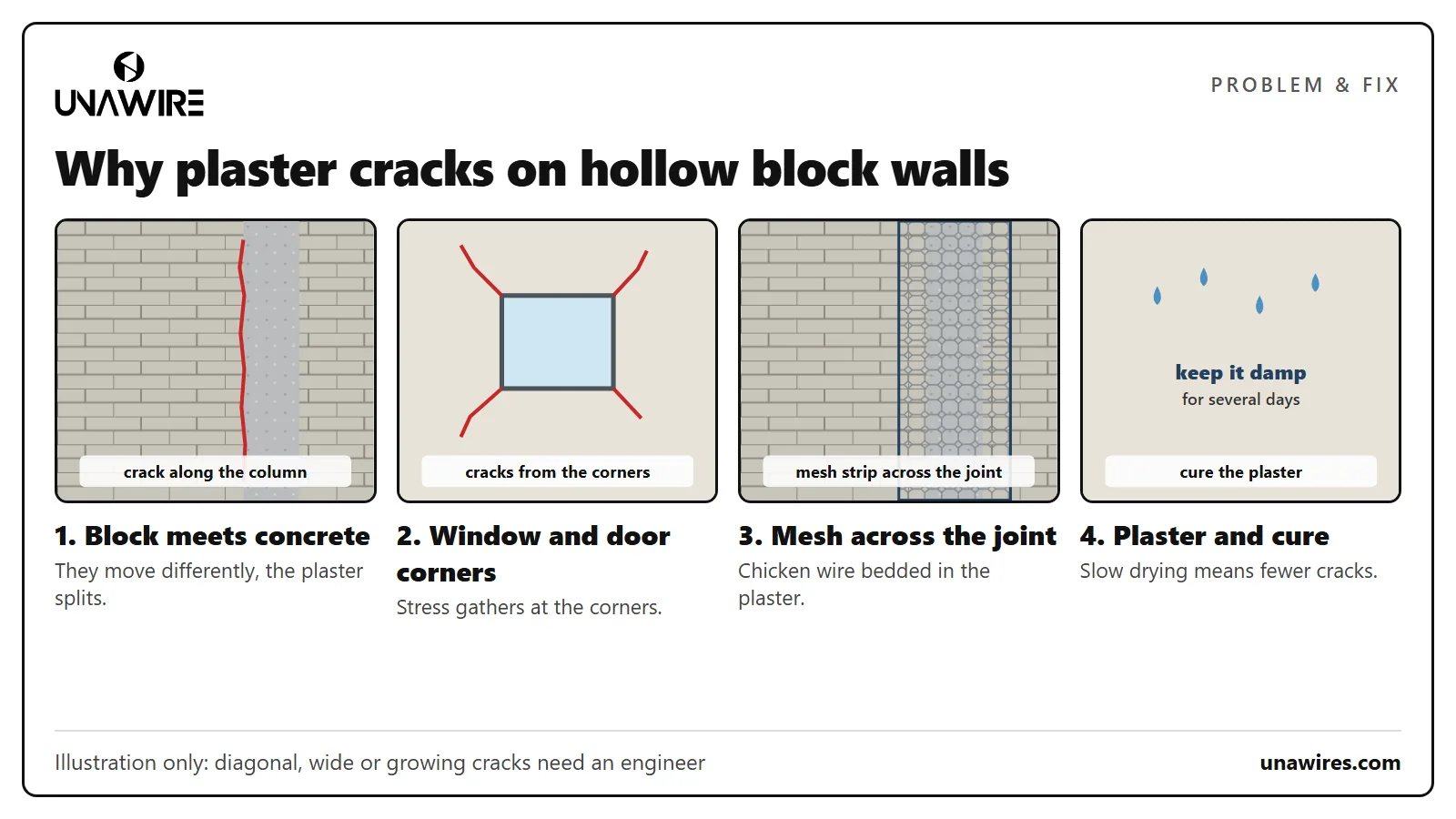
Most plaster cracks come from the plaster drying too fast, plaster put on too thick in one coat, and the joint where hollow blocks meet a concrete column or beam. Block and concrete move differently, so the plaster splits along that line. Cracks also start at the corners of windows and doors and over pipe and conduit chases. The usual prevention is a strip of wire mesh such as chicken wire embedded in the plaster across every block-to-concrete joint and diagonally at opening corners, plus proper curing. Diagonal, stepped, wide or growing cracks are not plaster problems: have an engineer look at them.
Fine lines in new plaster (nagcrack ang palitada) are one of the most common complaints after building or renovating. Most of them are cosmetic and come from how the plaster was put on and cured, or from where the hollow blocks meet the concrete frame. A few are a sign of movement in the structure. This guide shows how to tell them apart, why each kind happens, and how a cheap strip of wire mesh in the plaster prevents the most common ones.
6 Reasons Plaster Cracks
1. The plaster dried too fast
Sun, wind and dry hollow blocks pull water out of fresh plaster before it has set. The result is a fine "map" of short cracks over the surface. Fix: wet the wall before plastering, shade it from direct sun, and keep the plaster damp for several days.
2. Too thick in one coat
Plaster built up thick in a single coat to hide an uneven wall shrinks more and cracks. Fix: put thick plaster on in more than one coat, letting each coat firm up first, as your contractor specifies.
3. The joint between hollow block and concrete
This is the most common straight crack: a vertical line along a column, or a horizontal line under a beam. Concrete and hollow block shrink and move by different amounts, and the plaster across the joint splits. Fix: embed a strip of wire mesh in the plaster across the joint (see below).
4. Corners of windows and doors
Stress gathers at the corners of openings, so cracks run out diagonally from them. Fix: place short mesh strips diagonally across each corner in the plaster.
5. Pipe and conduit chases
Where the wall was cut for pipes or electrical conduit and then patched, the patch and the old wall move differently. Fix: cover the patched chase with a mesh strip before plastering.
6. A weak or badly mixed plaster
Too much sand, too much water, or old cement makes weak plaster that cracks and sounds hollow when tapped. Fix: mix to the proportion your contractor gives, and use fresh cement.
Is the Crack Serious?
| What you see | Likely cause | What to do |
|---|---|---|
| Fine cracks in a random pattern | Plaster dried too fast | Usually cosmetic. Fill and repaint. |
| Straight line along a column or under a beam | Block-to-concrete joint | Usually cosmetic. Repair with a mesh strip. |
| Short diagonal cracks from window or door corners | Stress at the opening | Usually cosmetic if thin. Repair with mesh at the corners. |
| Plaster sounds hollow when tapped | Plaster has come loose from the wall | Remove the loose area and re-plaster. |
| Diagonal or stair-step crack across the wall, wide, or getting longer | Movement in the structure or foundation | Ask an engineer before patching. |
| Cracks in columns or beams | Structural, outside this guide | Ask an engineer. |
A rough guide only. We supply wire and mesh; we do not inspect buildings.
How to Use a Mesh Strip in Plaster
- Cut strips of chicken wire long enough to cover the whole joint.
- Centre each strip on the joint, so it reaches well onto both the hollow block and the concrete. Your contractor will set the exact width.
- Fix it flat to the wall with concrete nails or tie wire so it does not bulge.
- Embed it in the plaster. The mesh should sit inside the plaster, fully covered, not on the surface.
- At openings, add short strips diagonally across each corner of windows and doors.
- Cure the plaster by keeping it damp for several days.
The mesh does not stop plaster from shrinking. It spreads the movement so you get fine, hidden hairlines instead of one open crack along the joint.
Which Mesh to Use
| Use | Mesh | Notes |
|---|---|---|
| Strips across joints, corners and chases in normal plaster | Chicken wire, 1 inch hex, #22 | Thin and flexible, lies flat inside normal plaster |
| Backing for a thick patch or a filled gap | Steel matting 1×1 inch | Rigid; for thick fills, not thin plaster |
What It Costs
Chicken wire comes in 90 ft (about 27.4 m) rolls. Our prices, October 2026: ₱1,600 for a 4 ft roll, ₱1,900 for 5 ft and ₱2,300 for 6 ft. A 4 ft roll cut lengthwise into four strips about 30 cm wide gives roughly 110 m of mesh strip (calculated), enough for the joints of a typical house. Cut narrower strips for chases and corners.
Mesh only. Nails, tie wire, cement and labour are extra. Strip width is your contractor's call.
Frequently Asked Questions
Why is the plaster on my hollow block wall cracking?
The usual reasons are the plaster drying too fast, plaster put on too thick in one coat, and the joint where the hollow blocks meet a concrete column or beam. Cracks also start at window and door corners and over patched pipe chases.
How do I stop plaster cracking between hollow blocks and columns?
Embed a strip of wire mesh such as chicken wire in the plaster across the joint, reaching onto both the block and the concrete, and keep the plaster damp for several days while it cures.
Are cracks in plaster serious?
Fine cracks in a random pattern and straight cracks along a column or beam line are usually cosmetic. Diagonal or stair-step cracks across the wall, wide cracks, cracks that keep growing, and any cracks in columns or beams should be checked by an engineer.
What wire mesh is used in plastering?
Chicken wire is the common choice for strips across joints, corners and chases, because it is thin and lies flat inside normal plaster. Heavier 1×1 inch steel matting is for thick patches and filled gaps.
How much chicken wire do I need for plaster joints?
A 4 ft by 90 ft roll cut into four strips about 30 cm wide gives roughly 110 m of strip. Our 4 ft roll is ₱1,600 as of October 2026.
See also why concrete floors crack, chicken wire guide, how to stop rats entering the house and all the uses of steel matting.
Plastering soon? Tell us the walls
Send the rough length of block-to-concrete joints in your project, or just the floor area, and your delivery address. We will suggest the rolls and send the price.
Get a Free Quote →