
Why do fences fall down in a typhoon?
Usually because the fence catches the wind like a sail (GI sheets, plywood, tarpaulin or banners tied to the fence), the posts are too shallow or not set in concrete, the posts have rusted at the ground, or the corners and ends are not braced. Soaked, soft soil after days of rain makes all of these worse. An open mesh fence such as cyclone wire or steel matting lets most of the wind pass through, so it puts far less force on the posts. Set the posts in concrete, brace the corners, use galvanized or painted steel, and take anything solid off the fence before a storm. For solid walls and anything tall, ask an engineer.
After every strong typhoon, the same pictures appear: GI sheet fences folded flat, hollow block walls leaning, and cyclone wire fences lying on the ground with the posts pulled out. Often the fence itself was fine; what failed was the way it was built or what was hung on it. This guide explains why fences go down in strong wind, what to check now, and how to build or repair a fence so it has a better chance of staying up next time.
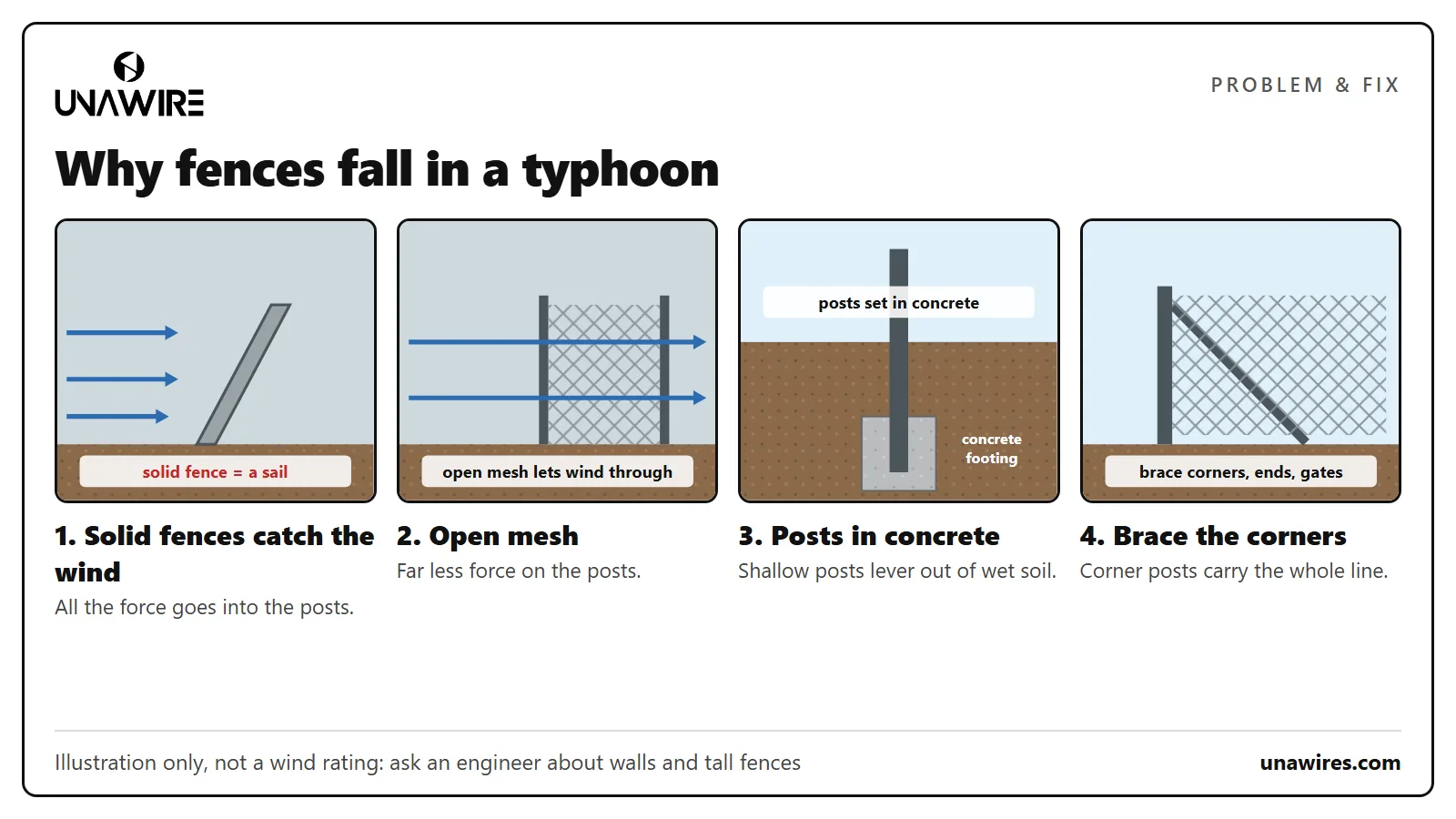
6 Reasons Fences Fall in Strong Wind
1. The fence is solid, so it acts like a sail
Wind pushes on everything it cannot pass through. A fence of GI sheets, plywood or solid panels takes the full force of the wind over its whole face, and all of that force goes into the posts. Fix: use open mesh where you do not need privacy, or have an engineer design a solid fence or wall for wind.
2. Tarpaulin, banners and sheets tied to a mesh fence
A mesh fence lets wind through, until someone ties a tarpaulin, shade net, banner or GI sheet to it. Then it becomes a sail too, and it usually falls in one piece. Fix: take everything solid off the fence before a typhoon.
3. Posts too shallow, or not set in concrete
Posts pushed into the soil or set in a small, shallow footing rock loose and lever out of the ground. Fix: set posts in concrete footings, deep enough for the fence height. Your contractor or engineer will size them for your soil.
4. Posts rusted at the ground line
Steel posts rust fastest where they meet wet soil or a concrete base. A post can look fine above and be thin at the bottom. Fix: use galvanized or painted posts, check the base every year, and replace thin ones before the typhoon season.
5. Corners, ends and gates not braced
The posts at corners, ends and gates carry the pull of the whole fence line. Without a diagonal brace they lean, and the fence goes with them. Fix: brace corner, end and gate posts, and use heavier posts there.
6. Soaked soil and falling trees
Days of rain before a typhoon soften the soil around footings, and branches and trees fall on fences. Fix: keep drainage away from the fence line, and trim trees and branches that hang over the fence before the season.
Which Fence Handles Wind Best?
| Fence | Wind passes through? | Notes |
|---|---|---|
| Cyclone wire | Mostly | Light and open. Needs firm posts and a top rail or tension wire so it does not sag. |
| Steel matting panels | Mostly | Rigid welded panels. Fix every panel firmly to the posts. |
| Anti-climb mesh | Partly | Narrow openings let less wind through than wider mesh, so posts and fixings matter more. |
| GI sheet or plywood | No | Takes the full wind force. Needs a stronger frame and footings. |
| Hollow block wall | No | Needs proper footing and reinforcement. Have an engineer check tall or leaning walls. |
A general guide, not a wind rating. We supply wire and mesh; we do not design fences for wind loads. For walls, tall fences and anything near a road or neighbour, ask an engineer.
Before the Typhoon: Checklist
- Remove tarpaulins, banners, shade nets and loose sheets from the fence.
- Check post bases for rust and cracks in the footings.
- Tighten panel clamps and tie wire; re-tie any loose sections.
- Trim branches that hang over the fence.
- Clear drains along the fence line so water does not pool at the footings.
- Close and secure the gate so it does not swing and tear the posts.
Rebuilding After a Typhoon
If the fence went down, look at what failed before you rebuild. Pulled-out posts mean the footings were too small or the soil too soft. Snapped posts mean rust or a post that was too light. Folded sheets mean the fence caught too much wind. Fix the cause, not just the fence. Our products and October 2026 prices:
| Product | Price |
|---|---|
| Cyclone wire, 10 m roll, 4 / 5 / 6 ft high | ₱2,100 / ₱2,600 / ₱3,000 per roll |
| Steel matting, 2×2 inch, 4×8 ft, black iron | From ₱318 per sheet (2.6 mm) |
| Barbed wire, #12, 140 m roll | ₱2,300 per roll |
Posts, cement, footings and labour are separate. See cyclone wire fence cost and how to measure your fence perimeter.
Frequently Asked Questions
Why did my fence fall down in the typhoon?
The usual reasons are a solid fence or something solid tied to it catching the wind, posts that were too shallow or not set in concrete, posts rusted at the ground, and corners or ends without bracing. Soft, soaked soil and falling branches make all of these worse.
What type of fence is best for typhoons?
An open mesh fence such as cyclone wire or steel matting lets most of the wind pass through, so it puts much less force on the posts than a solid fence. It still needs posts set in concrete and braced corners. Solid walls and tall fences should be designed by an engineer.
Should I remove the tarpaulin from my fence before a typhoon?
Yes. A tarpaulin, banner, shade net or sheet tied to a mesh fence turns it into a sail and can pull the whole fence down. Take them off before the storm.
How do I make my fence posts stronger against wind?
Set them in concrete footings sized for the fence height and soil, use galvanized or painted posts, brace the corner, end and gate posts, and check the bases for rust every year. Your contractor or engineer can size the footings.
Is a hollow block wall safer than a wire fence in a typhoon?
Not automatically. A hollow block wall takes the full force of the wind and depends on its footing and reinforcement. A well-built mesh fence lets wind through. Have an engineer check any tall, cracked or leaning wall.
See also cyclone wire guide, steel matting vs cyclone wire fence, how to stop people climbing your fence and all fence guides.
Rebuilding a fence? Send us the length
Tell us the length and height of the fence, what it is now (cyclone wire, sheets, wall) and your delivery address. We will reply with the wire or panels you need and the price.
Get a Free Quote →